Kids Taken From Family Due to Filthy Living Conditions Farmington,nm
| Baton the Kid | |
|---|---|
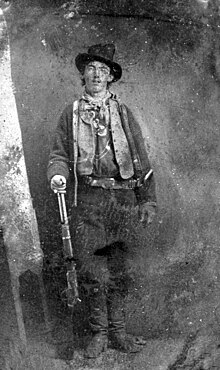 Photograph of Billy the Child, c. 1880 | |
| Born | Henry McCarty[1] September 17 or November 23, 1859 (disputed) New York City, U.s. |
| Died | July 14, 1881 (aged 21) Fort Sumner, New Mexico Territory |
| Cause of death | Gunshot wound |
| Resting place | One-time Fort Sumner Cemetery 34°24′13″N 104°11′37″W / 34.40361°N 104.19361°Westward / 34.40361; -104.19361 (Baton the Kid'due south Gravesite) |
| Other names | William H. Bonney, Henry Antrim, Kid Antrim |
| Occupation |
|
| Meridian | 5 ft vii in (ane.70 m) at historic period 17[2] |
Billy the Child (born Henry McCarty; September 17 or November 23, 1859 – July xiv, 1881), also known past the pseudonym William H. Bonney, was an outlaw and gunfighter of the American Erstwhile West, who killed 8 men before he was shot and killed at the age of 21.[3] [4] He likewise fought in New Mexico's Lincoln County War, during which he allegedly committed three murders.
McCarty was orphaned at the age of 15. His start arrest was for stealing food, at the age of 16, in late 1875. X days later, he robbed a Chinese laundry and was again arrested, merely escaped before long afterwards. He fled from New Mexico Territory into neighboring Arizona Territory, making himself both an outlaw and a federal fugitive. In 1877, McCarty began to call himself "William H. Bonney".[5] Ii versions of a wanted affiche dated September 23, 1875, refer to him every bit "Wm. Wright, ameliorate known as Billy the Kid".[ citation needed ]
After killing a blacksmith during an altercation in Baronial 1877, McCarty became a wanted man in Arizona and returned to New Mexico, where he joined a group of cattle rustlers. He became well known in the region when he joined the Regulators and took office in the Lincoln County State of war of 1878. McCarty and two other Regulators were later on charged with killing three men, including Lincoln County Sheriff William J. Brady and one of his deputies.
McCarty's notoriety grew in Dec 1880 when the Las Vegas Gazette, in Las Vegas, New Mexico, and The Sun, in New York City, carried stories near his crimes.[6] Sheriff Pat Garrett captured McCarty later that calendar month. In April 1881, McCarty was tried for and convicted of Brady's murder, and was sentenced to hang in May of that year. He escaped from jail on April 28, killing two sheriff's deputies in the process and evading capture for more than than two months. Garrett shot and killed McCarty, by and then age 21, in Fort Sumner on July 14, 1881. During the following decades, legends grew that McCarty had survived, and a number of men claimed to exist him.[7] Baton the Kid remains one of the most notorious figures from the era, whose life and likeness have been oft dramatized in Western popular culture.
Early on life [edit]
Henry McCarty was born to parents of Irish Catholic beginnings,[8] Catherine (née Devine) and Patrick McCarty, in New York Urban center. While his birth year has been confirmed as 1859, the exact date of his nascency has been disputed as either September 17 or November 23 of that year. A letter from an official of Saint Peter's Church in Manhattan states information technology is in possession of records showing McCarty was baptized in that location on September 28, 1859.[a] [10] [11] [12] Census records bespeak his younger brother, Joseph McCarty, was born in 1863.[xiii]
Following the death of her husband Patrick, Catherine McCarty and her sons moved to Indianapolis, Indiana, where she met William Henry Harrison Antrim. The McCarty family moved with Antrim to Wichita, Kansas, in 1870.[xiv] Afterward moving again a few years later, Catherine married Antrim on March i, 1873, at the Commencement Presbyterian Church in Santa Fe, New United mexican states Territory; McCarty and his brother Joseph were witnesses to the ceremony.[15] [16] Before long afterward, the family moved from Santa Iron to Silver Urban center, New Mexico, and Joseph McCarty began using the name Joseph Antrim.[13] Before long before McCarty'due south mother, Catherine, died of tuberculosis, then called "consumption", on September 16, 1874,[17] William Antrim abandoned the McCarty boys, leaving them orphans.
First crimes [edit]

McCarty was fifteen years old when his mother died. Sarah Brown, the owner of a boarding house, gave him room and board in exchange for work. On September 16, 1875, McCarty was defenseless stealing food.[eighteen] [nineteen] Ten days later, McCarty and George Schaefer robbed a Chinese laundry, stealing clothing and two pistols. McCarty was charged with theft and was jailed. He escaped two days later and became a fugitive,[18] every bit reported in the Silver City Herald the next mean solar day, the outset story published most him. McCarty located his stepfather and stayed with him until Antrim threw him out; McCarty stole clothing and guns from him. It was the concluding fourth dimension the ii saw each other.[twenty]
After leaving Antrim, McCarty traveled to southeastern Arizona Territory, where he worked as a ranch hand and gambled his wages in nearby gaming houses.[21] In 1876, he was hired as a ranch mitt past well-known rancher Henry Hooker.[22] [23] During this time, McCarty became acquainted with John R. Mackie, a Scottish-born criminal and former U.S. Cavalry private who, following his discharge, remained near the U.S. Army post at Camp Grant in Arizona. The two men soon began stealing horses from local soldiers.[24] [25] McCarty became known as "Kid Antrim" considering of his youth, slight build, clean-shaven appearance, and personality.[26] [27]
On August 17, 1877, McCarty was at a saloon in the village of Bonita when he got into an statement with Francis P. "Windy" Cahill, a blacksmith who reportedly had bullied McCarty and on more than than one occasion called him a "pimp". McCarty in turn called Cahill a "son of a bitch", whereupon Cahill threw McCarty to the floor and the ii struggled for McCarty's revolver. McCarty shot and mortally wounded Cahill. A witness said, "[Billy] had no option; he had to utilize his equalizer." Cahill died the following 24-hour interval.[28] [29] McCarty fled simply returned a few days afterwards and was apprehended by Miles Wood, the local justice of the peace. McCarty was detained and held in the Camp Grant guardhouse but escaped earlier law enforcement could go far.[30]
McCarty stole a horse and fled Arizona Territory for New Mexico Territory,[31] merely Apaches took the horse from him, leaving him to walk many miles to the nearest settlement. At Fort Stanton in the Pecos Valley,[32] McCarty—starving and near death—went to the dwelling house of friend and Seven Rivers Warriors gang member John Jones, whose mother Barbara nursed him dorsum to health.[33] [5] After regaining his health, McCarty went to Apache Tejo, a sometime regular army post, where he joined a band of rustlers who raided herds owned by cattle magnate John Chisum in Lincoln County. Afterwards McCarty was spotted in Silver City, his involvement with the gang was mentioned in a local newspaper.[34] At some point in 1877, McCarty began to refer to himself by the proper name "William H. Bonney".[five]
Lincoln Canton War [edit]
Prelude [edit]


Later on returning to New Mexico, McCarty worked every bit a cowboy for English language businessman and rancher John Henry Tunstall (1853–1878), most the Rio Felix, a tributary of the Rio Grande, in Lincoln County. Tunstall and his business organisation partner and lawyer Alexander McSween were opponents of an brotherhood formed by Irish-American businessmen Lawrence White potato, James Dolan, and John Riley. The three men had wielded an economic and political hold over Lincoln County since the early on 1870s, due in part to their buying of a beefiness contract with nearby Fort Stanton and a well-patronized dry goods store in the town of Lincoln.
Past February 1878, McSween owed $8,000 to Dolan, who obtained a court club and asked Lincoln Canton Sheriff William J. Brady to attach nearly $40,000 worth of Tunstall's belongings and livestock. Tunstall put Bonney in charge of nine prime horses and told him to relocate them to his ranch for safekeeping. Meanwhile, Sheriff Brady assembled a large posse to seize Tunstall'southward cattle.[35] [36]
On February 18, 1878, Tunstall learned of the posse'due south presence on his state and rode out to intervene. During the encounter, one member of the posse shot Tunstall in the chest, knocking him off his horse. Another posse fellow member took Tunstall's gun and killed him with a shot to the back of his head.[36] [37] Tunstall'southward murder ignited the conflict betwixt the ii factions that became known as the Lincoln County War.[36] [38]
Build-upward [edit]
After Tunstall was killed, McCarty and Dick Brewer swore affidavits against Brady and those in his posse, and obtained murder warrants from Lincoln County justice of the peace John B. Wilson.[39] On February xx, 1878, while attempting to arrest Brady, the sheriff and his deputies constitute and arrested McCarty and two other men riding with him.[twoscore] Deputy U.South. Align Robert Widenmann, a friend of McCarty, and a disengagement of soldiers captured Sheriff Brady's jail guards, put them behind confined, and released McCarty and Brewer.[41]
McCarty and then joined the Lincoln County Regulators; on March ix they captured Frank Baker and William Morton, both of whom were defendant of killing Tunstall. Baker and Morton were killed while allegedly trying to escape.[42]
On April ane, the Regulators ambushed Sheriff Brady and his deputies; McCarty was wounded in the thigh during the battle. Brady and Deputy Sheriff George Due west. Hindman were killed.[43] On the morning of April four, 1878, Buckshot Roberts and Dick Brewer were killed during a shootout at Blazer's Manufactory.[44] Warrants were issued for several participants on both sides, and McCarty and two others were charged with killing Brady, Hindman and Roberts.[45]
Boxing of Lincoln (1878) [edit]
On the night of Lord's day, July 14, McSween and the Regulators—now a group of fifty or sixty men—went to Lincoln and stationed themselves in the town among several buildings.[46] At the McSween residence were McCarty, Florencio Chavez, Jose Chavez y Chavez, Jim French, Harvey Morris, Tom O'Folliard, and Yginio Salazar, amidst others. Another group led by Marin Chavez and Physician Scurlock positioned themselves on the roof of a saloon. Henry Newton Brownish, Dick Smith, and George Coe defended a nearby adobe bunkhouse.[47] [48]
On Tuesday, July 16, newly appointed sheriff George Peppin sent sharpshooters to kill the McSween defenders at the saloon. Peppin'southward men retreated when one of the snipers, Charles Crawford, was killed by Fernando Herrera. Peppin then sent a asking for assistance to Colonel Nathan Dudley, commandant of nearby Fort Stanton. In a reply to Peppin, Dudley refused to arbitrate but afterward arrived in Lincoln with troops, turning the battle in favor of the Irish potato-Dolan faction.[49] [fifty]
A shooting war broke out on Friday, July nineteen. McSween'south supporters gathered within his firm; when Buck Powell and Deputy Sheriff Jack Long ready fire to the building, the occupants began shooting. McCarty and the other men fled the edifice when all rooms but one were burning. During the confusion, Alexander McSween was shot and killed by Robert Due west. Beckwith, who was then shot and killed past McCarty.[51] [52]
Outlaw [edit]


McCarty and iii other survivors of the Battle of Lincoln were most the Mescalero Indian Agency when the agency bookkeeper, Morris Bernstein, was murdered on August five, 1878. All four were indicted for the murder, despite conflicting evidence that Bernstein had been killed by Constable Atanacio Martinez. All of the indictments, except McCarty's, were afterward quashed.[53] [54]
On October 5, 1878, U.S. Marshal John Sherman informed newly appointed Territorial Governor and former Union Ground forces general Lew Wallace that he held warrants for several men, including "William H. Antrim, alias Kid, alias Attractive [sic]" but was unable to execute them "owing to the disturbed condition of affairs in that county, resulting from the acts of a drastic grade of men."[55] Wallace issued an amnesty annunciation on November 13, 1878, which pardoned anyone involved in the Lincoln Canton War since Tunstall's murder. It specifically excluded persons who had been convicted of or indicted for a law-breaking, and therefore excluded McCarty.[56] [57]
On February xviii, 1879, McCarty and friend Tom O'Folliard were in Lincoln and watched every bit attorney Huston Chapman was shot and his corpse assault fire. According to eyewitnesses, the pair were innocent bystanders forced at gunpoint past Jesse Evans to witness the murder.[58] [59] McCarty wrote to Governor Wallace on March xiii, 1879, with an offering to provide information on the Chapman murder in exchange for amnesty. On March xv, Governor Wallace replied, agreeing to a secret meeting to hash out the situation. McCarty met with Wallace in Lincoln on March 17, 1879. During the meeting and in subsequent correspondence, Wallace promised McCarty protection from his enemies and charity if he would offer his testimony to a 1000 jury.[b]
On March 20, Wallace wrote to McCarty, "to remove all suspicion of understanding, I think information technology better to put the arresting party in accuse of Sheriff Kimbrell [sic] who shall be instructed to see that no violence is used."[c] McCarty responded on the aforementioned twenty-four hour period, agreeing to prove and confirming Wallace's proposal for his arrest and detention in a local jail to assure his safety.[62] [63] On March 21, McCarty allow himself be captured past a posse led by Sheriff George Kimball of Lincoln County. As agreed, McCarty provided a statement about Chapman's murder and testified in court.[64] However, after McCarty's testimony, the local commune attorney refused to set him free.[65] [66] Notwithstanding in custody several weeks after, McCarty began to suspect Wallace had used subterfuge and would never grant him amnesty. McCarty escaped from the Lincoln Canton jail on June 17, 1879.[67]
McCarty avoided farther violence until Jan 10, 1880, when he shot and killed Joe Grant, a newcomer to the expanse, at Hargrove's Saloon in Fort Sumner, New Mexico.[68] The Santa Iron Weekly New Mexican reported, "Baton Bonney, more extensively known as 'the Kid,' shot and killed Joe Grant. The origin of the difficulty was not learned."[69] According to other contemporary sources, McCarty had been warned Grant intended to kill him. He walked up to Grant, told him he admired his revolver, and asked to examine it. Grant handed information technology over. Before returning the pistol, which he noticed independent only three cartridges, McCarty positioned the cylinder and then the next hammer fall would state on an empty sleeping room. Grant of a sudden pointed his pistol at McCarty's face and pulled the trigger. When it failed to fire, McCarty drew his ain weapon and shot Grant in the head. A reporter for the Las Vegas Optic quoted McCarty equally proverb the meet "was a game of two and I got there first."[seventy] [71]
In 1880, McCarty formed a friendship with a rancher named Jim Greathouse, who later introduced him to Dave Rudabaugh. On November 29, 1880, McCarty, Rudabaugh, and Billy Wilson ran from a posse led by sheriff's deputy James Carlysle. Cornered at Greathouse's ranch, McCarty told the posse they were holding Greathouse as a hostage. Carlysle offered to substitution places with Greathouse, and McCarty accepted the offer. Carlysle later attempted to escape by jumping through a window but he was shot three times and killed.[72] The shootout ended in a standoff; the posse withdrew and McCarty, Rudabaugh, and Wilson rode abroad.[73] [74]
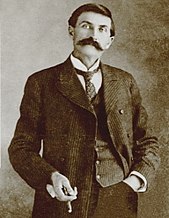
Sheriff Pat Garrett, c. 1903

A few weeks after the Greathouse incident, McCarty, Rudabaugh, Wilson, O'Folliard, Charlie Bowdre, and Tom Pickett rode into Fort Sumner. Unbeknownst to McCarty and his companions, a posse led past Pat Garrett was waiting for them. The posse opened burn, killing O'Folliard; the residual of the outlaws escaped unharmed.[75] [76]
Capture and escape [edit]

Deputy Align Bob Olinger
On December 13, 1880, Governor Wallace posted a $500 bounty for McCarty's capture.[77] Pat Garrett connected his search for McCarty; on Dec 23, following the siege in which Bowdre was killed, Garrett and his posse captured McCarty along with Pickett, Rudabaugh, and Wilson at Stinking Springs. The prisoners, including McCarty, were shackled and taken to Fort Sumner, and then afterwards to Las Vegas, New United mexican states. When they arrived on December 26, they were met by crowds of curious onlookers.
The post-obit day, an armed mob gathered at the train depot before the prisoners, who were already on board the railroad train with Garrett, departed for Santa Fe.[78] Deputy Sheriff Romero, backed by the angry grouping of men, demanded custody of Dave Rudabaugh, who during an unsuccessful escape endeavour on Apr 5, 1880 shot and killed deputy Antonio Lino Valdez in the process.[79] Garrett refused to surrender the prisoner, and a tense confrontation ensued until he agreed to allow the sheriff and ii other men back-trail the political party to Santa Fe, where they would petition the governor to release Rudabaugh to them.[fourscore] In a later interview with a reporter, McCarty said he was unafraid during the incident, saying, "if I but had my Winchester I'd lick the whole crowd."[81] [82] The Las Vegas Gazette ran a story from a jailhouse interview post-obit McCarty'southward capture; when the reporter said Bonney appeared relaxed, he replied, "What'south the utilize of looking on the gloomy side of everything? The express joy's on me this time."[83] During his short career as an outlaw, McCarty was the subject of numerous U.S. newspaper manufactures, some as far away as New York.[84]
After arriving in Santa Fe, McCarty, seeking clemency, sent Governor Wallace four letters over the next three months. Wallace refused to arbitrate,[85] and McCarty went to trial in April 1881 in Mesilla, New Mexico.[86] Post-obit two days of testimony, McCarty was establish guilty of Sheriff Brady's murder; it was the only conviction secured against whatever of the combatants in the Lincoln Canton War. On April 13, Approximate Warren Bristol sentenced McCarty to hang, with his execution scheduled for May 13, 1881.[86] Co-ordinate to legend, upon sentencing, the gauge told McCarty he was going to hang until he was "dead, dead, expressionless"; McCarty's response was, "you can become to hell, hell, hell."[87] According to the historical record, he did non speak after the reading of his judgement.
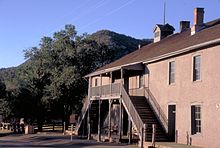

Marker noting the site where Deputy Olinger (spelled here as "Ollinger") was killed by McCarty
Following his sentencing, McCarty was moved to Lincoln, where he was held under baby-sit on the peak floor of the town courthouse. On the evening of April 28, 1881, while Garrett was in White Oaks collecting taxes, Deputy Bob Olinger took five other prisoners across the street for a meal, leaving James Bell,[89] another deputy, lone with McCarty at the jail. McCarty asked to exist taken outside to utilise the outhouse behind the courthouse; on their render to the jail, McCarty—who was walking ahead of Bong up the stairs to his jail cell—hid around a blind corner, slipped out of his handcuffs, and beat Bell with the loose end of the cuffs. During the ensuing scuffle, McCarty grabbed Bell's revolver and fatally shot him in the back equally Bell tried to get away.[xc]
McCarty, with his legs notwithstanding shackled, broke into Garrett's office and took a loaded shotgun left backside by Olinger. McCarty waited at the upstairs window for Olinger to answer to the gunshot that killed Bell and called out to him, "Look up, erstwhile male child, and encounter what you get." When Olinger looked upwardly, Bonney shot and killed him.[90] [91] [92] After well-nigh an hour, McCarty freed himself from the leg irons with an axe.[93] He obtained a equus caballus and rode out of town; co-ordinate to some stories he was singing as he left Lincoln.[91]
Recapture and death [edit]
While McCarty was on the run, Governor Wallace placed a new $500 bounty on the fugitive'southward caput.[94] [95] [96] About iii months after his escape, Garrett, responding to rumors that McCarty was in the vicinity of Fort Sumner, left Lincoln with two deputies on July 14, 1881, to question resident Pete Maxwell, a friend of McCarty's.[97] Maxwell, son of land baron Lucien Maxwell, spoke with Garrett the same mean solar day for several hours. Effectually midnight, the pair sat in Maxwell'southward darkened bedroom when McCarty unexpectedly entered.[98]
Accounts vary every bit to the course of events. According to the approved version, equally he entered the room, McCarty failed to recognize Garrett due to the poor lighting. Drawing his revolver and bankroll away, McCarty asked "¿Quién es? ¿Quién es?" (Spanish for "Who is information technology? Who is it?").[99] Recognizing McCarty's voice, Garrett drew his revolver and fired twice.[100] The first bullet struck McCarty in the chest only above his eye, while the 2d missed. Garrett'due south account leaves it unclear whether McCarty was killed instantly or took some time to die.[98] [101]
A few hours later on the shooting, a local justice of the peace assembled a coroner'south jury of six people. The jury members interviewed Maxwell and Garrett, and McCarty's trunk and the location of the shooting were examined. The jury certified the trunk equally McCarty'due south and, co-ordinate to a local newspaper, the jury foreman said, "Information technology was the Kid'south body that we examined."[102] McCarty was given a wake by candlelight; he was cached the adjacent day and his grave was denoted with a wooden mark.[103] [104]
5 days after McCarty's killing, Garrett traveled to Santa Fe, New United mexican states, to collect the $500 reward offered by Governor Lew Wallace for his capture, dead or alive. William G. Ritch, the acting New Mexico governor, refused to pay the reward.[105] Over the next few weeks, the residents of Las Vegas, Mesilla, Santa Fe, White Oaks, and other New United mexican states cities raised over $7,000 in reward money for Garrett. A twelvemonth and four days after McCarty'south death, the New Mexico territorial legislature passed a special deed to grant Garrett the $500 bounty reward promised by Governor Wallace.[106]
Considering people had begun to merits Garrett unfairly ambushed McCarty, Garrett felt the need to tell his side of the story and called upon his friend, announcer Marshall Upson, to ghostwrite a book for him.[107] The book, The Authentic Life of Baton, the Kid,[d] was first published in Apr 1882.[109] Although only a few copies sold following its release, in time, it became a reference for later historians who wrote about McCarty's life.[107]
Rumors of survival [edit]
Over time, legends grew challenge that McCarty was not killed, and that Garrett staged the incident and death out of friendship so that McCarty could evade the police force.[110] During the next fifty years, a number of men claimed they were Baton the Kid.[ commendation needed ] Most of these claims were hands disproven, merely 2 have remained topics of discussion and contend.
In 1948, a primal Texas human being, Ollie P. Roberts, too known as Brushy Bill Roberts, began challenge he was Billy the Kid and went earlier New United mexican states Governor Thomas J. Mabry seeking a pardon. Mabry dismissed Roberts' claims, and Roberts died soon afterwards.[111] Nevertheless, Hico, Texas, Roberts' boondocks of residence, capitalized on his claim by opening a Billy the Kid museum.[112]
John Miller, an Arizona human being, also claimed he was McCarty. This was unsupported by his family unit until 1938, some time after his expiry. Miller'due south body was buried in the country-owned Arizona Pioneers' Home Cemetery in Prescott, Arizona; in May 2005, Miller's teeth and bones[113] were exhumed and examined,[114] without permission from the country.[115] Deoxyribonucleic acid samples from the remains were sent to a laboratory in Dallas and tested to compare Miller's DNA with claret samples obtained from floorboards in the old Lincoln County courthouse and a demote where McCarty's body allegedly was placed after he was shot.[116] Co-ordinate to a July 2015 article in The Washington Mail service, the lab results were "useless."[113]
In 2004, researchers sought to exhume the remains of Catherine Antrim, McCarty's female parent, whose DNA would exist tested and compared with that of the body cached in William Bonney'due south grave.[117] Equally of 2012[update], her body had not been exhumed.[116]
In 2007,[118] author and amateur historian Gale Cooper filed a lawsuit against the Lincoln County Sheriff's Office under the state Inspection of Public Records Act to produce records of the results of the 2006 DNA tests and other forensic evidence collected in the Billy the Kid investigations.[119] In April 2012, 133 pages of documents were provided; they offered no conclusive evidence confirming or disproving the generally accepted story of Garrett'southward killing of McCarty, [118] but confirmed the records' existence, and that they could have been produced earlier.[116] In 2014, Cooper was awarded $100,000 in punitive damages simply the determination was later overturned by the New Mexico Court of Appeals.[120] The lawsuit ultimately cost Lincoln Canton about $300,000.[118]
In Feb 2015, historian Robert Stahl petitioned a district court in Fort Sumner asking the state of New Mexico to effect a decease document for McCarty.[102] In July 2015, Stahl filed suit in the New Mexico Supreme Courtroom. The accommodate asked the court to order the state's Office of the Medical Investigator to officially certify McCarty's decease under New Mexico state police.[121]
Photographs [edit]
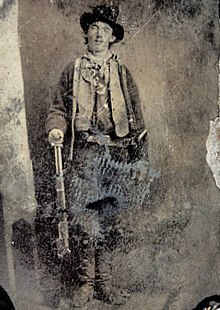
Unretouched original ferrotype of McCarty, c. 1880

Particular from photograph purporting to prove McCarty (left) playing croquet in 1878
As of 2021[update], just one authenticated photograph showing Billy exists; others thought to depict him are disputed.[122]
Dedrick ferrotype [edit]
1 of the few remaining artifacts of McCarty'southward life is a 2-by-3-inch (5.1-by-7.6-centimeter) ferrotype photograph of McCarty by an unknown portrait lensman in late 1879 or early 1880. The paradigm shows McCarty wearing a vest over a sweater, a slouch chapeau and a bandana, while belongings an 1873 Winchester rifle with its barrel resting on the flooring. For years, this was the only photograph scholars and historians agreed showed McCarty.[95] The ferrotype survived because McCarty's friend Dan Dedrick kept it after the outlaw'due south death. It was passed down through Dedrick'due south family, and was copied several times, appearing in numerous publications during the 20th century. In June 2011, the original plate was bought at auction for $2.3 one thousand thousand by businessman William Koch.[123] [124]
The epitome shows McCarty wearing his holstered Colt revolver on his left side. This led historians to believe he was left-handed, simply they did not take into account that the ferrotype process produces reversed images.[125] In 1954, western historians James D. Horan and Paul Sann wrote that McCarty was right-handed and carried his pistol on his correct hip.[126] The opinion was confirmed past Clyde Jeavons, a one-time curator of the National Motion-picture show and Tv Archive.[127] Several historians take written that McCarty was ambidextrous.[128] [129] [130] [131]
Croquet tintype [edit]
A 4-by-6-inch (100 mm × 150 mm) ferrotype purchased at a memorabilia shop in Fresno, California, in 2010 has been claimed to bear witness McCarty and members of the Regulators playing croquet. If accurate, information technology is the just known photo of Billy the Child and the Regulators together and the only epitome to feature their wives and female companions. [132] Collector RobertG. McCubbin and outlaw historian John Boessenecker concluded in 2013 that the photo does not show McCarty.[133] Whitny Braun, a professor and researcher, located an advertisement for croquet sets sold at Chapman's Full general Store in Las Vegas, New United mexican states, dated to June 1878. Kent Gibson, a forensic video and still image expert, offered the services of his facial recognition software, and stated that McCarty is indeed one of the individuals in the prototype.[134]
In August 2015, Lincoln State Monument officials and the New United mexican states Section of Cultural Affairs said that despite the new research, they could non confirm that the image showed McCarty or others from the Lincoln County War era, co-ordinate to Monument manager Gary Cozzens. A photograph curator at the Palace of the Governors archives, Daniel Kosharek, said the image is "problematic on a lot of fronts," including the small size of the figures and the lack of resemblance of the groundwork landscape to Lincoln County or the country in general.[134] Editors from the True West Magazine staff said, "no one in our office thinks this photo is of the Child [and the Regulators]."[133]
In early on Oct 2015, Kagin'south, Inc., a numismatic authentication firm, said the prototype was authentic after a number of experts, including those associated with a recent National Geographic Channel plan,[135] [136] examined it.[137] [138]
Posthumous pardon request [edit]
In 2010, New United mexican states Governor Nib Richardson turned down a request for a posthumous pardon of McCarty for the murder of Sheriff William Brady. The pardon considered was to fulfill Governor Lew Wallace's 1879 promise to Bonney. Richardson's decision, citing "historical ambiguity," was announced on Dec 31, 2010, his last day in part.[139] [140]
Grave markers [edit]

The "PALs" gravemarker for Tom O'Folliard, William H. Bonney, alias Baton the Kid, and Charlie Bowdre, at Fort Sumner, New Mexico

Grave marker for Billy The Kid, too at Fort Sumner, New Mexico
In 1931, CharlesW.Foor, an unofficial tour guide at Fort Sumner Cemetery, campaigned to raise funds for a permanent marker for the graves of McCarty, O'Folliard, and Bowdre. As a result of his efforts, a stone memorial marked with the names of the iii men and their death dates beneath the word "Pals" was erected in the center of the burial expanse.[141]
In 1940, stone cutter James Due north. Warner of Salida, Colorado, made and donated to the cemetery a new marking for Bonney's grave.[142] It was stolen on February 8, 1981, but recovered days later in Huntington Beach, California. New Mexico Governor Bruce Male monarch bundled for the county sheriff to fly to California to render information technology to Fort Sumner,[143] where it was reinstalled in May 1981. Although both markers are behind iron fencing, a group of vandals entered the enclosure at nighttime in June 2012 and tipped the stone over.[144]
Popular culture [edit]
Start with the 1911 silent motion-picture show "Baton the Kid", which depicted McCarty as a daughter impersonating a boy,[145] he has been a feature of more than l movies including:
- The Adventures of Billy, another 1911 silent flick directed by D. W. Griffith, Starring Edna Foster equally a girl impersonating a boy (Baton)[146]
- Billy the Child (John Mack Brown as Baton)
- The Outlaw (Jack Buetel as Billy)
- The Left Handed Gun (Paul Newman as Baton)
- Chisum (Geoffrey Deuel as Billy)
- Pat Garrett and Billy the Child (Kris Kristofferson as Billy)
- Dirty Footling Billy (Michael J. Pollard as Billy)
- The Authentic Life of Billy, the Kid (book)
- Immature Guns (Emilio Estevez as Billy)
- Young Guns Ii (Emilio Estevez as Billy)
- The Kid (Dane DeHaan as Billy)
- Old Henry (Tim Blake Nelson as Baton)
- Nib & Ted's Excellent Run a risk (Dan Shor equally Billy)
Idiot box:
- Maverick episode: "Full House" (Joel Gray as Billy)
- The Tall Man (Clu Gulager as Billy)
- Gore Vidal'due south Billy the Kid (Val Kilmer as Baton)
See also [edit]
- Folklore of the United States
- List of Old West gunfighters
- List of Quondam W lawmen
Notes [edit]
- ^ Letter from Rev. James B. Roberts, Church of St. Peter, New York City, to Jack DeMattos, March 24, 1979.[9]
- ^ For years Wallace denied that he had agreed to the bargain with McCarty; however, in a newspaper article published in 1902, Wallace changed his story and said he had promised McCarty a pardon in change for the testimony.[lx]
- ^ Letter from Governor Wallace to W.H. Bonney, March twenty, 1879.[61]
- ^ The full title of the Garrett-Upson volume was The Authentic Life of Baton, the Kid, the Noted Desperado of the Southwest, Whose Deeds of Daring and Blood Made His Name a Terror in New United mexican states, Arizona and Northern United mexican states. By Pat. F. Garrett, Sheriff of Lincoln Co., N.M., By Whom He Was Finally Hunted Down and Captured by Killing Him. [108]
References [edit]
- ^ Nolan, Frederick (2015). The West of Baton the Kid. Academy of Oklahoma Press. p. 29. ISBN978-0-8061-4887-8. Archived from the original on September 2, 2021. Retrieved July 1, 2019.
- ^ Utley 1989, p. 15.
- ^ Rasch 1995, pp. 23–35.
- ^ Wallis 2007, pp. 244–45.
- ^ a b c Wallis 2007, p. 144.
- ^ Utley 1989, pp. 145–46.
- ^ "The Erstwhile Human being Who Claimed to Be Billy the Kid". Atlas Obscura. March xxx, 2017. Archived from the original on July 8, 2017. Retrieved July 19, 2017.
- ^ "Life and death of Baton the Kid". The Clare Champion. July 15, 2010. Archived from the original on Feb 26, 2020. Retrieved November 13, 2020.
- ^ DeMattos 1980.
- ^ Nolan 2009a, pp. i–6.
- ^ Rasch & Mullin 1953, pp. 1–v.
- ^ Rasch 1954, pp. vi–11.
- ^ a b Nolan 1998, pp. xv, 29.
- ^ Wallis 2007, p. 15.
- ^ Nolan 1998, pp. 17–19.
- ^ Nolan 2009a, p. 7.
- ^ Nolan 2009a, p. eight.
- ^ a b "Billy The Kid: Facts, data and manufactures about Billy The Kid, famous outlaw, and a prominent figure from the Wild W". HistoryNet.com. Archived from the original on January 3, 2016. Retrieved Jan 4, 2016.
- ^ Grant County Herald (Silvery City, New United mexican states), September 26, 1875.
- ^ Wallis 2007, pp. 94–95.
- ^ Wallis 2007, p. 103.
- ^ "Billy the Kid". State of New Mexico. Archived from the original on January 26, 2016. Retrieved January half dozen, 2016.
- ^ Utley 1989, pp. x–xi.
- ^ Wallis 2007, p. 107.
- ^ Utley 1989, pp. eleven–12.
- ^ Wallis 2007, pp. 110–11.
- ^ Utley 1989, p. sixteen.
- ^ Radbourne, Allan; Rasch, Philip J. (Baronial 1985). "The Story of 'Windy' Cahill". Existent West (204): 22–27.
- ^ "This Date in History – Baronial 17, 1877 – Baton the Kid kills his first man". History Channel. Archived from the original on March 15, 2016. Retrieved Jan 17, 2016.
- ^ Wroth, William H. "Baton the Kid". New United mexican states Office of the State Historian. Archived from the original on January 26, 2016. Retrieved February 10, 2016.
- ^ Wallis 2007, p. 119.
- ^ Nolan 1998, p. 77.
- ^ Hays, Republic of chad (March 19, 2013). "Ma'am Jones A sew together in time". Truthful W Magazine. Archived from the original on December 22, 2015. Retrieved February 10, 2016.
- ^ Wallis 2007, pp. 123–31.
- ^ Nolan 2009a, pp. 188–90.
- ^ a b c Boardman, Marking (September 25, 2010). "The Tunstalls Return – John Tunstall's kin traveled from England to fathom death in Lincoln". True West Magazine. Archived from the original on Feb 16, 2016. Retrieved Feb x, 2016.
- ^ Utley 1989, p. 46.
- ^ Nolan 2009a, pp. 23–55.
- ^ Utley 1989, pp. 48–49.
- ^ Bell, Bob Boze (April 1, 2004). "I Shot the Sheriff (and I Killed a Deputy, Too) – Billy Kid and the Regulators vs Sheriff Brady and His Deputies". True West Mag. Archived from the original on February xvi, 2016. Retrieved February 10, 2016.
- ^ Bell, Bob Boze (September 11, 2015). "Tunstall Ambushed – Regulators vs Dolan's Henchmen". True W Mag. Archived from the original on Feb sixteen, 2016. Retrieved Feb eleven, 2016.
- ^ Utley 1989, pp. 56–60.
- ^ Nolan 2009a, pp. 233–49, 549.
- ^ Rickards, Colin. The Gunfight at Blazer'southward Factory, 1974 – pp. 36–37.
- ^ Wroth, William H. Billy the Child Archived January 26, 2016, at the Wayback Machine. Retrieved January 9, 2016.
- ^ Jacobsen 1994, p. 173.
- ^ Nolan 1992, pp. 312–xiii.
- ^ Utley 1987, p. 87.
- ^ Nolan 1992, p. 513.
- ^ "New Mexico Office of the Land Historian | people". newmexicohistory.org. Archived from the original on June 29, 2017. Retrieved July 19, 2017.
- ^ Nolan 1992, pp. 322–31.
- ^ Utley 1987, pp. 96–111.
- ^ Utley 1989, pp. 104–05, 107, 110.
- ^ Nolan 2009a, pp. 339–40, 342, 445, 514.
- ^ Utley 1987, p. 120.
- ^ Nolan 2009a, pp. 315, 515.
- ^ Utley 1987, pp. 122–23, 126–28, 141, 150, 154, 156–158.
- ^ Utley 1987, pp. 132–136, 139, 141, 143–144.
- ^ Nolan 1992, pp. 375–76, 378, 516–17.
- ^ Cooper 2017, pp. 556–61.
- ^ Cooper 2017, pp. 563–65.
- ^ Cooper 2017, p. 565.
- ^ Boomhower 2005, p. 103.
- ^ Boomhower 2005, p. 104.
- ^ Boomhower 2005, pp. 106–07.
- ^ Lifson 2009.
- ^ Utley 1989, pp. 111–25.
- ^ Bell, Bob Boze (May 2, 2007). "The Tale of the Empty Sleeping room Billy the Kid vs Joe Grant". Truthful Westward Magazine. Archived from the original on February 16, 2016. Retrieved January 10, 2016.
- ^ Santa Fe Weekly New Mexican, January 17, 1880.
- ^ Utley 1989, pp. 131–33, 145, 203, 249–250.
- ^ Nolan 1992, pp. 397, 518, 572.
- ^ "Deputy Sheriff James Carlysle". The Officer Down Memorial Page (ODMP). Archived from the original on September 25, 2020. Retrieved November 19, 2020.
- ^ Utley 1989, pp. 143–46, 179, 204.
- ^ Nolan 1992, pp. 398–401.
- ^ Metz 1974, pp. 74–75.
- ^ Utley 1989, pp. 155–57, 256–57.
- ^ Utley 1989, p. 147.
- ^ Wallis 2007, p. 240.
- ^ "Deputy Sheriff Antonio Lino Valdez profile". The Officer Downwards Memorial Page, Inc. Archived from the original on November 27, 2020. Retrieved December thirty, 2019.
- ^ Wallis 2007, pp. 126–27.
- ^ Metz 1974, pp. 76–85.
- ^ Utley 1989, pp. 157–66.
- ^ "Book Review: Billy the Child's Writings, Words & Wit, by Gale Cooper". HistoryNet. Nov 29, 2012. Archived from the original on September 19, 2015. Retrieved February 10, 2016.
- ^ Utley 1989, pp. 145–47.
- ^ Wallis 2007, pp. 240–41.
- ^ a b Wallis 2007, p. 242.
- ^ "1881 Billy the Kid is shot to death". History.com. Archived from the original on February 15, 2016. Retrieved Feb 10, 2016.
- ^ "Deputy Sheriff James Westward. Bell". The Officer Down Memorial Page (ODMP). Archived from the original on Oct 23, 2020. Retrieved August 14, 2020.
- ^ a b Utley 1989, p. 181.
- ^ a b Wallis 2007, pp. 243–44.
- ^ "Deputy U.Due south. Marshal Robert Olinger". The Officeholder Downwards Memorial Page (ODMP). Archived from the original on August 4, 2020. Retrieved Baronial 14, 2020.
- ^ Jacobsen 1994, p. 232.
- ^ Utley 1989, p. 188.
- ^ a b Boardman, Marking (May 24, 2011). "The Holy Grail for Sale – The Billy the Kid tintype is on the auction block, and it might merely clear half a million". True Due west Magazine. Archived from the original on March five, 2016. Retrieved February 10, 2016.
- ^ Villagran, Lauren (December 1, 2013). "Is this Billy the Kid?". Albuquerque Periodical – Las Cruces Bureau. Archived from the original on December xv, 2016. Retrieved February 6, 2016.
- ^ Wallis 2007, pp. 245–46.
- ^ a b Wallis 2007, p. 247.
- ^ Frederick Nolan (2014). The Billy the Kid Reader. Academy of Oklahoma Printing. p. 86. ISBN978-0-8061-8254-four. Archived from the original on July ix, 2021. Retrieved July 4, 2021.
- ^ Janofsky, Michael (June v, 2003). "122 Years Later, Lawmen Are Nevertheless Chasing Baton the Kid". The New York Times. p. 24. Archived from the original on January 25, 2019. Retrieved January 25, 2019.
- ^ "The Expiry Of Billy The Kid, 1881". Bystander to History/Ibis Communications. Archived from the original on Feb 19, 2020. Retrieved February 18, 2020.
- ^ a b Klein, Christopher (February 27, 2015). "Historian Seeks Death Certificate to End Billy the Kid Rumors". History.com. Archived from the original on March four, 2016. Retrieved Feb 10, 2016.
- ^ Rose, Elizabeth R. (December 31, 2012), "Ft. Sumner New United mexican states: Where Baton The Kid met his demise", Santa Fe Examiner
- ^ Bell, Bob Boze; Gardner, Mark Lee (Baronial 12, 2014). "A Shot in the Dark: Billy the Kid vs Pat Garrett". True Due west Mag. Archived from the original on February 16, 2016. Retrieved February 10, 2016.
- ^ "Santa Fe Daily New Mexican Newspaper", Santa Atomic number 26 Daily New Mexican, p. 4, July 21, 1881
- ^ (New Mexico Territorial Legislature July xviii, 1882).
- ^ a b Utley 1989, pp. 198–99.
- ^ Utley 1989, p. 199.
- ^ LeMay, John and Stahl, Robert J. (2020). The Human Who Invented Billy the Kid: The Accurate Life of Ash Upson. Roswell, NM: Bicep Books. pp. 127–33. ISBN978-1-953221-91-9.
- ^ Wallis 2007, p. xiv.
- ^ "Field & Stream". Field & Stream 2007–08: 106–. July 1981. ISSN 8755-8599. Archived from the original on Nov one, 2017. Retrieved July 20, 2017.
- ^ Texas Department of Transportation, Texas Land Travel Guide, 2008, pp. 200–201
- ^ a b Miller, Michael Due east. (July 21, 2015). "One man'due south quest to bury the Wild Due west mystery of Baton the Child's death". The Washington Post. Archived from the original on December 23, 2015. Retrieved December 25, 2015.
A family Bible put his historic period in 1881 at just 2 years old: far also young for even a criminal nicknamed 'the Kid'.
- ^ Banks, Leo W. "A New Billy the Kid?". Tucson Weekly. Archived from the original on June 16, 2009. Retrieved August 4, 2008.
- ^ Associated Press (October 24, 2006) ii won't face charges in Billy the Kid quest Archived February 1, 2016, at the Wayback Machine, Deseret News. Retrieved August 29, 2008.
- ^ a b c Burns, James T. (April 28, 2012). "Billy the Kid and New Mexico Open Records Constabulary". Albuquerque Business organisation Police force. Archived from the original on Dec 26, 2015. Retrieved Dec 25, 2015.
- ^ Miller, Patrick (March 18, 2004). "Shootout over Billy the Kid". The Christian Science Monitor. Archived from the original on December 22, 2015. Retrieved December 13, 2015.
- ^ a b c Villagran, Lauren (May 20, 2014). "Award ends arrange over Billy the Kid records". Albuquerque Journal. Archived from the original on August 19, 2017. Retrieved December 25, 2015.
- ^ Associated Printing (August 28, 2008) Lawsuit seeks DNA testify for 1881 expiry of Billy the Kid Archived August nineteen, 2017, at the Wayback Machine, Play tricks News Channel. Retrieved August 29, 2008.
- ^ "Billy the Kid quest evolves into records fight". pressreader.com. Archived from the original on Baronial nineteen, 2017. Retrieved Baronial 18, 2017.
- ^ Constable, Anne (July 17, 2015). "Historian asks state's high court to assist set tape straight on Billy the Kid'southward death". The Santa Fe New Mexican. Archived from the original on November viii, 2020. Retrieved Dec 14, 2015.
- ^ "Flea market photograph 'shows Billy the Kid'". BBC News. November 22, 2017. Archived from the original on November 22, 2017. Retrieved November 23, 2017.
- ^ Tripp, Leslie (June 26, 2011). "Billy the Kid photograph fetches $2.3 million at auction". CNN. Archived from the original on July 6, 2015. Retrieved July 4, 2015.
- ^ "Billy the Child portrait fetches $2.3m at Denver auction". BBC News US & Canada. June 26, 2011. Archived from the original on Feb 29, 2016. Retrieved January 26, 2016.
- ^ Adetunji, Jo (June 26, 2011). "Billy the Kid photo sold at auction in Colorado for $2.3m". The Guardian. Archived from the original on March 5, 2016. Retrieved December 28, 2015.
- ^ Horan, James D. and Sann, Paul. Pictorial History of the Wild Westward, New York: Crown Publishers, Inc., 1954 – p. 57.
- ^ Mayes, Ian (March 3, 2001). "I kid y'all not". The Guardian. Archived from the original on March 12, 2014. Retrieved June 19, 2009.
- ^ Gardner, Marker Lee: To Hell on a Fast Horse: The Untold Story of Billy the Kid and Pat Garrett (2011), pp. 91, 277
- ^ Nolan 1998, p. 29.
- ^ Wallis 2007, p. 83.
- ^ Goode, Stephen (June 10, 2007). "The fact and fiction of America'south outlaw". The Washington Times. Archived from the original on June 20, 2009. Retrieved December 25, 2015.
Billy loved to sing and had a good phonation, those who knew him claimed ... He was ambidextrous and wrote well with both hands.
- ^ Constable, Anne (August 24, 2015). "Billy the Kid: A fan of croquet?". The New Mexican. Archived from the original on May 8, 2020. Retrieved December x, 2017.
- ^ a b "Billy the Kid Experts Weigh in on the Croquet Photograph". Truthful Due west Magazine. October 14, 2015. Archived from the original on March 1, 2016. Retrieved February 3, 2016.
- ^ a b Lawman, Anne (August 24, 2015). "Billy the Kid: A fan of croquet?". Santa Fe New Mexican. Archived from the original on May viii, 2020. Retrieved September 23, 2015.
- ^ Guijarro, Randy (October 18, 2015). "Baton the Child: New Evidence. Institute Photograph". National Geographic. Archived from the original on December 14, 2017. Retrieved December 10, 2017.
- ^ "Billy the Kid: New Evidence". National Geographic. October eighteen, 2015. Archived from the original on December xi, 2017. Retrieved December 10, 2017.
- ^ Booker, Brakkton (October xv, 2015). "$two Photo Establish at Junk Store Has Baton The Child in It, Could Be Worth $5M". NPR. Archived from the original on Jan 26, 2016. Retrieved Jan 25, 2016.
- ^ Carroll, Rory (October 19, 2015). "Homo who discovered rare Billy the Kid photo: 'The hunt is a really grand matter'". The Guardian. Archived from the original on Oct 28, 2015. Retrieved October 27, 2015.
- ^ "No pardon for Billy the Kid". CNN. December 31, 2010. Archived from the original on November nine, 2012. Retrieved Dec 31, 2010.
- ^ "An Outlaw past Any Name: Billy the Child". The New York Times. July 14, 2016. Archived from the original on January 29, 2017.
- ^ Simmons 2006, pp. 161–63.
- ^ Simmons 2006, pp. 164–65.
- ^ "Billy the Child's Elusive Tombstone / Old Fort Sumner and Billy the Kid's Grave". Cemeteries-of-tx.com. Archived from the original on May 27, 2016. Retrieved February 9, 2016.
- ^ Lohr, David (June 30, 2012). "'Billy the Kid' tombstone in New Mexico vandalized". The Huffington Post. Archived from the original on July 4, 2012. Retrieved March 21, 2013.
- ^ "When Baton the Kid Was Billie the Child". October ix, 2014. Archived from the original on October 16, 2016. Retrieved July 6, 2017.
- ^ The Adventures of Billy (1911) – Biograph, D.W. Griffith, archived from the original on October 22, 2020, retrieved July thirteen, 2021
Sources [edit]
- Adams, Ramon F. (1960). A Fitting Decease for Billy the Child . Norman, Oklahoma: University of Oklahoma Press. OCLC 8937525.
- Boomhower, Ray E. (2005). The Sword and the Pen. Indianapolis: Indiana Historical Society Printing. p. 103. ISBN0-87195-185-1.
- Burns, Walter (2014). The Saga of Baton the Kid: The Thrilling Life of America's Original Outlaw. Garden City, New York: Skyhorse Publishing. ISBN978-1-63220-112-6. OCLC 894170041. Retrieved May 12, 2016.
- Coe, George West. (1934). Frontier Fighter: The Autobiography of George W. Coe Who Fought and Rode with Baton the Kid, as Related to Nan Hillary Harrison. Boston: Houghton Mifflin. OCLC 692143776. Archived from the original on June xiii, 2019. Retrieved August 29, 2016.
- Cooper, Gale (2017). The Lost Pardon of Billy the Kid: An Assay Factoring in the Santa Fe Ring, Governor Lew Wallace's Dilemma, and a Territory in Rebellion. Albuquerque, New United mexican states: Gelcour Books. ISBN978-0986070723.
- DeMattos, Jack (November 1978). "The Search for Baton the Kid's Roots". Real West. No. 160. Real West.
- DeMattos, Jack (January 1980). "The Search for Billy the Kid'south Roots – Is Over!". Real West. No. 167. Existent West.
- DeMattos, Jack (August 1983). "Gunfighters of the Real West: Henry McCarty, Allonym 'Billy the Kid'". Real West. No. 192. Real Westward.
- Dworkin, Mark J. (2015). American Mythmaker: Walter Noble Burns and the Legends of Baton the Child, Wyatt Earp, and Joaquín Murrieta. Norman, Oklahoma: University of Oklahoma Press. ISBN978-0-8061-4902-8. Archived from the original on June 12, 2019. Retrieved June thirteen, 2016.
- Dykes, Jefferson (1952). Billy the Kid: The Bibliography of a Legend. Albuquerque, New Mexico: The University of New Mexico Press. Archived from the original on June 9, 2019. Retrieved August 29, 2016.
- Earle, James H. (1988). The Capture of Billy the Child. College Station, Texas: Creative Publishing Co. ISBN0-932702-44-9. OCLC 18052460.
- Edwards, Harold L. (1995). Goodbye Baton the Kid. College Station, Texas: Artistic Publishing Co. ISBN1-57208-000-0. OCLC 33335740.
- Fable, Edmund, Jr. (1980) [1881]. The True Life of Baton the Child, The Noted New Mexican Outlaw. Higher Station, Texas: Creative Publishing Co. ISBN0-932702-xi-2. OCLC 6487191.
- Fulton, Maurice Garland (1968). Robert N. Nullin (ed.). History of the Lincoln County War. Tucson, Arizona: University of Arizona Printing. OCLC 437868.
- Gardner, Marking Lee (2010). To Hell on a Fast Horse: Baton the Kid, Pat Garrett, and the Epic Chase to Justice in the Sometime W. New York: William Morrow. ISBN978-0-06-136827-1. OCLC 419859633.
- Garrett, Pat F. (1882). The Authentic Life of Baton, the Kid (1st ed.). Santa Fe, New Mexico: New Mexican Printing and Publishing Visitor. OCLC 748293298.
- Hough, Emerson (September 1901). "Billy the Kid: The Truthful Story of a Western 'Bad Homo'". Everybody's Magazine. New York: The Ridgeway Company. Archived from the original on September 2, 2021. Retrieved August 28, 2016.
- Hunt, Frazier (2009) [1956]. The Tragic Days of Billy the Kid. Santa Atomic number 26, New United mexican states: Sunstone Press. ISBN978-0-86534-717-5. OCLC 316327276. Archived from the original on December 23, 2016. Retrieved November 21, 2017.
- Jacobsen, Joel (1994). Such Men every bit Billy the Kid: The Lincoln County War Reconsidered. Lincoln, Nebraska: University of Nebraska Press. ISBN978-0-8032-2576-3. OCLC 29429457.
- Keleher, William Aloysius (2007) [1957]. Violence in Lincoln County 1869–1881. Santa Atomic number 26, New United mexican states: Sunstone Press. ISBN978-0-86534-622-2. OCLC 182573474.
- Klasner, Lily; Chisum, John Simpson; Ball, Eve (1972). My Girlhood Among Outlaws . Tucson, Arizona: Academy of Arizona Press. ISBN978-0-8165-0354-4. OCLC 166482848.
- Koop, Waldo E. (1964). "Baton the Kid: The Trail of a Kansas Fable". Kansas City Posse of Westerners. Ix (three).
- Lifson, Amy (2009). "Ben-Hur". Humanities. Vol. 30, no. vi. Washington, D.C.: National Endowment for the Humanities. Archived from the original on March v, 2012. Retrieved August 27, 2014.
- McCubbin, Robert Thousand. (May 2007). "The Many Faces of Billy the Kid". True W. Truthful W.
- Metz, Leon C. (August 1983). "My Search for Pat Garrett and Billy the Kid". True West. Truthful West.
- Metz, Leon C. (1983) [1974]. Pat Garrett: The Story of a Western Lawman (reprint, revised ed.). Norman, Oklahoma: Academy of Oklahoma Press. ISBN978-0-8061-1838-3. OCLC 18722891.
- Nolan, Frederick Westward. (2009a). The Life and Decease of John Henry Tunstall. Santa Atomic number 26, New Mexico: Sunstone Press. ISBN978-0-86534-722-nine. OCLC 440562959.
- Nolan, Frederick Westward. (2009) [1992]. The Lincoln Canton War: A Documentary History (revised ed.). Santa Atomic number 26, New United mexican states: Sunstone Press. ISBN978-0-86534-721-2. OCLC 319064671. Archived from the original on June 11, 2019. Retrieved May 12, 2016.
- Nolan, Frederick W. (1992). The Lincoln County War: A Documentary History. Norman, Oklahoma: Academy of Oklahoma Press.
- Nolan, Frederick W. (June 2003). "The Hunting of Billy the Kid". Wild West. Wild West.
- Nolan, Frederick W. (1998). The West of Billy the Kid. Norman, Oklahoma: University of Oklahoma Press. ISBN0-8061-3082-ii.
- Nolan, Frederick Westward. (July 2000). "The Private Life of Billy the Kid". True West. True W.
- Nolan, Frederick W. (2007). The Billy the Kid Reader. Norman, Oklahoma: University of Oklahoma Printing. ISBN978-0-8061-8446-3.
- Otero, Miguel (2006) [1936]. The Real Billy the Child, With New Light on the Lincoln County War. New York: Sunstone Press. ISBN978-1-61139-100-eight.
- Poe, John William (2006) [1933]. The Expiry of Billy the Child (reprint ed.). Santa Fe: Sunstone Printing Company. ISBN978-0-86534-532-4.
- Radbourne, Allan; Rasch, Phillip J. (Baronial 1985). "The Story of 'Windy' Cahill". Real West. No. 204. Real West.
- Rasch, Philip J.; Mullin, Robert N. (1953). "New Light on the Legend of Billy the Kid". New Mexico Folklore Record seven.
- Rasch, Philip J. (1954). "Dim Trails: The Pursuit of the McCarty Family". New United mexican states Folklore Record 8.
- Rasch, Philip J. (1955). "The Twenty-One Men He Put Bullets Through". New Mexico Folklore Record 9.
- Rasch, Philip J. (January 1969). "A Second Await at the Blazer's Mill Affair". Frontier Times.
- Rasch, Philip J. (Nov 1987). "The Trials of Billy the Kid". Real West. No. 216. Real Due west.
- Rasch, Philip J. (1995). Trailing Billy the Child. Stillwater, Oklahoma: Western Publications. ISBN978-0-935269-xix-two.
- Rasch, Philip J. (1997). Gunsmoke in Lincoln County. Stillwater, Oklahoma: Western Publications. ISBN978-0-935269-24-half-dozen.
- Rasch, Philip J. (1998). Warriors of Lincoln Canton. Stillwater, Oklahoma: Western Publications. ISBN978-0-935269-26-0.
- Rickards, Colin W. (1974). "The Gunfight at Blazer's Manufactory". Southwestern Studies Monograph No. twoscore. El Paso, Texas: Western Press.
- Simmons, Mark (2006). Stalking Billy the Kid: Brief Sketches of a Brusk Life. Sunstone Press. ISBN0-86534-525-2.
- Turk, David S. (February 2007). "Billy the Child and the U.S. Marshals Service". Wild Westward Magazine. Archived from the original on August 17, 2018. Retrieved November 2, 2017.
(issued December 2006)
- Tuska, Jon (1983). Billy the Kid: A Handbook. Lincoln, Nebraska: University of Nebraska Press. ISBN0-8032-9406-ix.
- Utley, Robert K. (1987). High Apex in Lincoln: Violence on the Western Borderland . Albuquerque, New Mexico: Academy of New Mexico Printing. ISBN978-0-8263-1201-3. OCLC 15629305. Retrieved May 12, 2016.
- Utley, Robert Thousand. (1989). Billy the Kid: A Short and Violent Life. Lincoln, Nebraska: Academy of Nebraska Printing. ISBN978-0-8032-9558-2. OCLC 37868038. Archived from the original on June 11, 2019. Retrieved May 12, 2016.
- Wallis, Michael (2007). Billy the Child: The Endless Ride . New York: W. W. Norton & Co. ISBN978-0-393-06068-3. OCLC 77270750. Retrieved Nov 21, 2017.
External links [edit]
- Billy the Child Territory – guide past New Mexico Tourism Department
- Letter of the alphabet, fifteen March 1879, Lew Wallace to W. H. Bonney, at the Indiana Historical Society, Indianapolis
- Letter, xx March 1879, W. H. Bonney to Lew Wallace, at the Indiana Historical Lodge, Indianapolis
Source: https://en.wikipedia.org/wiki/Billy_the_Kid
0 Response to "Kids Taken From Family Due to Filthy Living Conditions Farmington,nm"
Postar um comentário